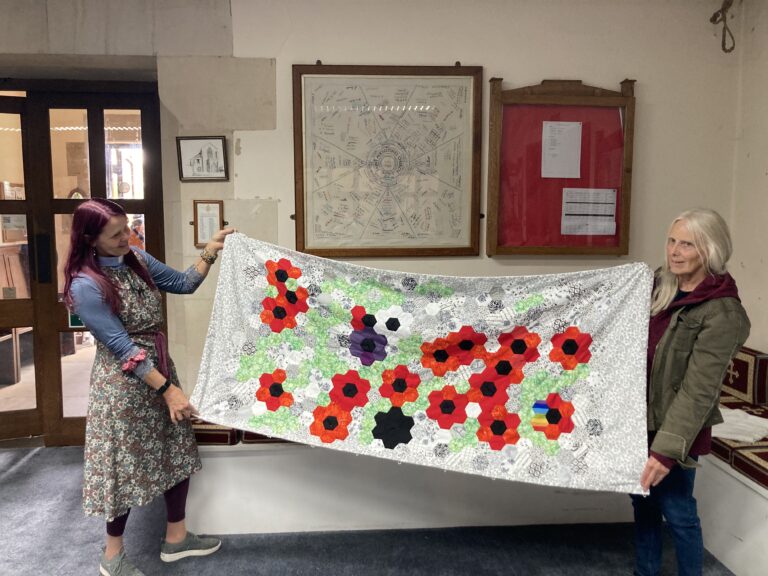
St Augustine’s Church has received a beautiful new Frontal.
This commemorative quilt was created and sewn, collectively, by Medway Patchers, a sewing and patchwork group of local people.
We are delighted to present it to St Augustine’s Church, Gillingham, as commemoration and as a symbol of hope and inclusiveness.
The design was inspired not only by British Legion poppies but also by a Pinterest image of a flower quilt in a small, local exhibition in Denmark in 2012. Attempts to track down and credit the artist for inspiring us are on-going.
English Paper Piecing was used to make the hexagons; this is a hand sewing technique using paper templates which are removed at the final stage. The quilt was finished off by machine and tied, partially ‘big-stitched’ and bound by hand.
The fabrics used in the background, reverse and binding are predominantly re-used cottons and poly-cottons from household textiles and clothing. They contain many images of nature: birds, flowers, leaves and butterflies.
British Legion red poppies, used in the UK, the USA, Canada and Australia, were first produced in 1921 and commemorate everyone who gave their lives in war: servicemen, servicewomen and civilians, They also represent hope.
Other flower colours symbolise other perspectives, selected by group members. It is important to stress that whilst they ALL commemorate everyone, they also raise the visibility of groups which have previously been overlooked.
White poppies, first made for sale in 1933, particularly emphasize achieving peace, and challenge the way we look at war. They also commemorate conscientious objectors (eg Quakers) who fulfilled non-combatant roles in conflict.
Black poppies highlight the sacrifices during wars of servicemen, servicewomen and civilians from black, Caribbean, African and Pacific Islander communities. Black poppies were first worn in a UK initiative in 2010.
In this quilt, the rainbow petals on one poppy particularly remember those who have died in war, but in their lives faced discrimination or marginalisation due to their sexual orientation or gender identity. In the last few years, The British Legion has introduced a Pride Poppy Badge with a rainbow ribbon, as a symbol of hope and acceptance around the world.
Finally, the purple poppy commemorates animals which have died in war: for example the horses and ponies who were killed in WW1. The purple poppy was first used in 2006.
While there has been no national initiative to specifically honour those people from Indian Sub-continent backgrounds (India, Pakistan, Bangladesh and Nepal) who were killed either in service or as civilians, some of the white fabric used here deliberately features motifs from this region. For example, during WW1, more than 200,000 Gurkhas served in the British Army.
We would like to say a huge thank you to the Sewing group members who made this quilt:
Priti, Jackie, Maz, Sandra, Sylvia, Sarah, Anne-Marie, Becky, Elizabeth, Joy, Karen, Kelly B, Kelly M, Linda B, Linda F and Cathy
This frontal will be used on Remembrance Sunday